The Guide
Endometriosis & IVF
- Endometriosis affects 1 in 10 women of reproductive age — average time to diagnosis is 7 to 10 years
- Many women with endo have no obvious symptoms and don't find out until they're struggling to get pregnant
- There is a documented link between endometriosis, ADHD, and autoimmune conditions
- Excision surgery is the gold standard — not ablation. They are not the same thing and the difference matters enormously.
- An endometriosis specialist is not the same as a general OB/GYN — seek out a specialist for surgery
- If you are planning both IVF and excision surgery — strongly consider doing all egg retrievals first, then surgery, then transfers
- BCL-6 positive endo patients have less than 12% chance of successful pregnancy without treatment intervention
- A non-invasive saliva test for endometriosis diagnosis is emerging in Europe and the UK — not yet available in the US
- Low dose naltrexone, low dose GLP-1s, and the ENDO-205 peptide are emerging treatment options worth knowing about
- If you are on Lupron Depot, get your thyroid tested — Lupron can significantly raise or lower TSH
- Women with endo may need higher progesterone levels before transfer — target above 37 to 40 ng/mL
I didn't find my endometriosis. Infertility did.
For years I had no idea anything was wrong. I didn't have the symptoms you're supposed to have — no debilitating periods, none of the classic pain that finally gets a woman taken seriously. If you'd asked me, I'd have told you I was fine. So nothing got investigated, because from the outside there was nothing to investigate.
Here's the part that still gets me. I wasn't chasing this down on my own — I was already in fertility treatment at Kaiser at the time. Their fertility department kept seeing persistent cysts on my ovaries, and because of those cysts, they sent me for a more thorough pelvic ultrasound in October 2021. And there it was, in my own chart: probable endometriomas on both ovaries, endometrial and cervical polyps, and in the radiologist's own words, "bilateral endometriomas with working diagnosis of endometriosis." It was named. It was documented. And then it was set aside — because the note said the cysts didn't warrant excision "unless symptomatic," and I wasn't symptomatic. So the plan was to watch and wait.
Read that again — and here's what makes it worse. I wasn't a random patient who wandered in for a scan. I was already under the care of Kaiser's fertility department. They were the ones who kept seeing persistent cysts on my ovaries. They were the ones who sent me for a more thorough ultrasound because of those cysts. And when it came back "bilateral endometriomas with working diagnosis of endometriosis," the very team whose job was to find out why I couldn't get pregnant filed it under "watch and wait" — because I wasn't symptomatic. Endometriosis is a known cause of infertility. They were looking for the cause. It was right there in front of them, and it was set aside.
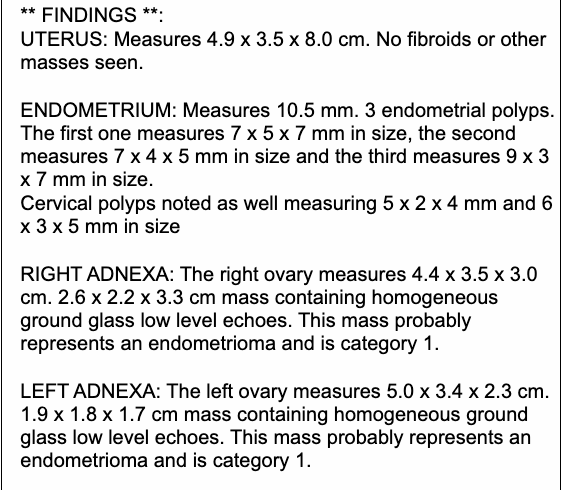
It took infertility to force the issue. As we started down the IVF road and transfers kept failing, I went looking for answers nobody had offered me. That search led to a ReceptivaDx test, and my BCL-6 came back at 2.4 — well above the threshold, pointing squarely at endometriosis-driven inflammation. It led to surgery, and when I finally had excision, the diagnosis was Stage 4. Stage 4 — from a woman who "had no symptoms." My surgeon, Dr. Katherine Garvey, was extraordinary — the first person who felt like they were treating the disease instead of managing around it.
But here's the part that still makes me angry, and I only fully understood it today, while building this page.
That BCL-6 test I paid for, that pointed to endometriosis? My 2021 ultrasound already said the same thing. "Bilateral endometriomas with working diagnosis of endometriosis" — it was written in my chart in 2021. I didn't need a specialized test years later to tell me I had endometriosis. It was already documented. We could have treated it then.
And I want to be honest about how I found this out: I did not know, until September 14, 2026 — the day I built this page — that my own chart from 2021 said the cysts "did not warrant excision unless symptomatic." I was reading back through my records to write this story, and there it was. Five years later. The answer had been sitting in my file the whole time, and no one had connected it, including me, because I didn't know to look.
So here we are in 2026, and we still don't have a baby. But the pieces were on the table in 2021. If someone — including me — had stopped, looked at the whole picture, and connected the dots, I might have saved years.
That is why I am so relentless about this now, and why I'm begging you to be relentless too: be involved in your own care to a degree that feels almost excessive. Read your own charts. Ask what every finding means and what the plan is. Do not assume that because something is documented, someone is acting on it. I had a working diagnosis of endometriosis in 2021 and didn't know the full story until 2026. Do not let that be you.