The Guide
The Embryo Transfer
- Most transfer cycles are either medicated or modified natural — you have a say in which one you do
- Clinics default to medicated cycles because it's easier for their scheduling — not necessarily because it's better for you
- A modified natural cycle uses your body's own hormones as the foundation — your clinic monitors your natural follicle development and triggers ovulation at the right time
- Your lining needs to reach at least 7mm before transfer — ideally 8 to 9mm — and be trilaminar (three distinct layers on ultrasound)
- Progesterone timing is critical — synced to the age of your embryo at the time it was frozen
- For endo patients, progesterone levels should ideally be above 37 to 40 ng/mL before transfer
- A modified natural cycle WITHOUT a trigger shot introduces timing imprecision that a trigger shot eliminates — ask specifically whether your clinic uses a trigger shot in modified natural cycles
- You can do remote monitoring locally and only travel to your clinic for the actual transfer
- If your lining is struggling, there are options — ask about PRP, Viagra, increasing estrogen, or switching protocols
A Hard Question About My Transfer Timing
My Kaiser transfers were timed to my ERA result — the test said my window was 125 hours of progesterone, and that is what I was given. At the time, that felt like precision. Knowing what I know in 2026, I am no longer sure it was.
The reason: the current research on the ERA is not reassuring. A 2026 meta-analysis found ERA-guided timing did not improve live birth rates over standard timing, and earlier work argued the test may not accurately identify a person's true window of implantation at all. So it is entirely possible my transfers were timed precisely to a number that was never right for me. Hitting the wrong target accurately is still missing.
I cannot prove that is what happened — no one measured my actual progesterone levels before or after those transfers, so I am missing half the picture entirely. But two things I would insist on now: ask whether the ERA's recommendation is worth trusting for your situation given the current evidence, and demand that your actual progesterone levels be measured, not just your timing managed. Timing to an unverified target, with unmeasured levels, is how I went through four failed transfers without ever knowing what was really going on.
The Main Types of Transfer Cycles
Modified Natural Cycle with Trigger Shot
Your clinic monitors your natural follicle development. When the lead follicle reaches the right size and your lining looks ready, they trigger ovulation with an HCG injection. Progesterone starts after confirmed ovulation and transfer is timed from there.
This is my preferred approach — both for myself and for our surrogate. Your body's own hormones support the cycle rather than relying entirely on external medication. The trigger shot is important — it controls the precise timing of ovulation so that progesterone start and transfer timing are synchronized correctly.
Real example — Kaiser FET #1, December 2022: Letrozole + HCG trigger + Endometrin vaginal suppositories 3x daily + Estrace 2mg + Medrol + Doxycycline + Valium day of transfer. Timeline: HCG trigger 12/4/2022, progesterone (Endometrin) started 12/7/2022, transfer 12/11/2022 — approximately 21 days total from CD1 (period started 11/20/2022). Important note: this was a day 6 embryo, which needs 6 full days of progesterone before transfer. Mine was transferred on progesterone day 5 — roughly 2 days too early for a day 6 embryo. The embryo and my lining were not properly synchronized. I did not catch this at the time. It is one of the reasons I now check every detail of transfer timing myself.
Fully Medicated Cycle
Everything is controlled by external hormones. No trigger shot. Estrogen builds the lining, then progesterone is added at a calculated time before transfer. The clinic controls the entire timeline — which is why clinics prefer this approach.
Real example — Kaiser FET #2, April 2023: Birth control pills 23 days beforehand + Lupron downregulation + Estrace 2mg 3x daily for 3 weeks + Progesterone in Oil 1mL IM daily at 7am exactly + Medrol + Doxycycline + Valium. Total cycle 22 days from CD1 to transfer.
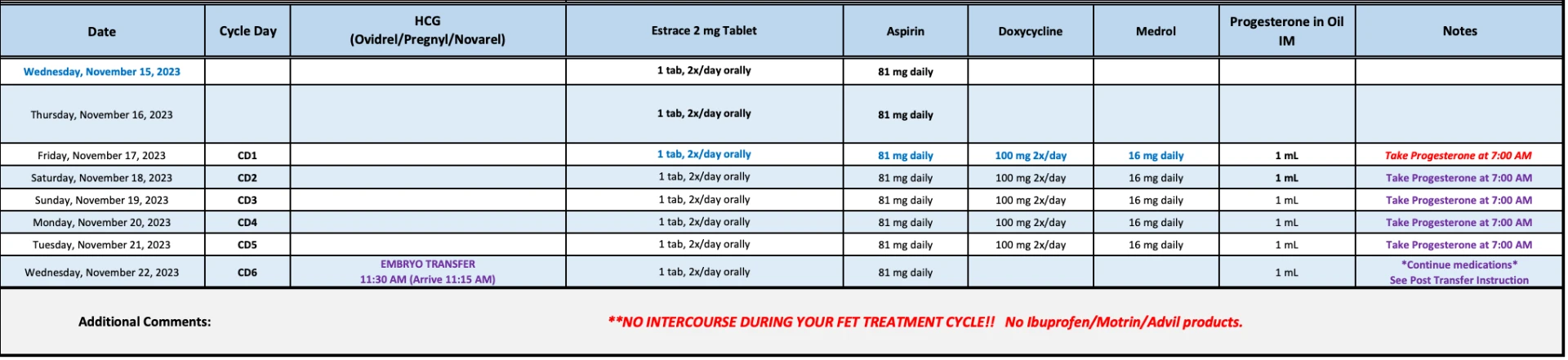
Real example — Kaiser FET #3, November 2023 (my first cycle after a positive endometriosis marker): This cycle followed a positive ReceptivaDx result — my BCL-6 came back at 2.4 (positive; threshold is 1.4), consistent with endometriosis. Because of that, the protocol added 60 days of hormone suppression before the transfer: two Lupron Depot shots, then a modified natural cycle. Medications: aspirin 81mg daily + Letrozole (cycle day 3 for 5 days) + hCG trigger + Estrace 2mg 3x daily + Progesterone in Oil 1mL IM daily at 7am + Medrol + Doxycycline + Valium. Timeline: Progesterone in Oil started 11/17/2023, transfer 11/22/2023 — progesterone day 6. Important note: this was another day 6 embryo, which should transfer on progesterone day 7. Mine was transferred on progesterone day 6 — one day early. This is the second of my Kaiser transfers where a day 6 embryo was transferred earlier than its developmental age called for (my first was transferred two days early). One day is a smaller mismatch than the two days in my first transfer, and I cannot prove it changed the outcome — but seeing the same timing error twice is exactly why I now count progesterone days against embryo age myself, every single time.
Modified Natural with Immune Protocol
A modified natural or medicated cycle with additional immune-modulating medications layered on top — typically for patients with recurrent implantation failure, elevated BCL-6, autoimmune concerns, or endometriosis-related immune issues.
Immune protocol medications may include: Prednisone or Medrol, Tacrolimus, Intralipid infusions, LIT therapy, Innohep or Lovenox, HCG wash, PRP.
Real example — Victory FET #4, December 2, 2024: Letrozole + Zpack antibiotics (both partners) + Flora Sap vaginal probiotic + Estrace escalating from 1mg to 4mg + Prednisone 25mg + Tacrolimus 3mg + Prometrium vaginally 3x daily + Progesterone in Oil 50mg IM nightly (increased to 75mg post-transfer) + Innohep daily + Intralipid infusion day of transfer + PRP uterine infusion + LIT session. Total cycle 41 days. Pre-transfer progesterone: approximately 35 ng/mL.
Low Estrogen Protocol for Endometriosis
Some clinicians start estrogen at a lower dose (1mg instead of the typical 2mg) based on the premise that endometriosis is estrogen-dependent and higher estrogen could drive disease activity. This is a legitimate clinical philosophy — but lower estrogen means the lining may take significantly longer to build, particularly after recent hormonal suppression. If your clinic recommends this approach, ask specifically why it's appropriate for your situation and what the plan is if your lining doesn't respond.
Thin Lining — What to Ask About
If your lining is struggling to reach target thickness ask about:
- increasing estrogen dose
- changing the form of estrogen (oral vs vaginal vs patch)
- Viagra (sildenafil) suppositories
- PRP uterine infusion
- G-CSF (Neupogen) uterine infusion
- acupuncture for uterine blood flow
Remote Monitoring
You don't always have to be at your clinic for every appointment. For my Victory transfer I did all monitoring at Capitol Imaging in Sacramento and bloodwork through RequestATest — then flew to Canada only for the transfer. CNY also allows remote monitoring. Ask your clinic: can I do monitoring locally and only come to you for the transfer?
Questions to Ask Before Your Transfer Cycle
- What type of transfer cycle are you recommending and why is it right for my specific situation?
- Is there a clinical reason for birth control suppression before this cycle or is it for scheduling?
- Can I do a modified natural cycle instead?
- If modified natural — will you use a trigger shot to precisely control ovulation timing?
- Can I do remote monitoring locally?
- What is your target lining thickness and what do we do if I don't reach it?
- Will you check my progesterone levels before and after transfer?
- If I have endometriosis what is your progesterone target?
- What immune support do you offer and do you think I need it based on my history?
A Hard Lesson About Travel Timing
If you're doing remote monitoring and traveling to your clinic for the actual transfer, here is something I learned the hard way that I wish someone had told me:
Do not book your travel until your lining is ready.
For our Victory transfer, I was doing remote monitoring in Sacramento. My lining was consistently building — slowly, but building. It got to around 6, then 6.5, then 6.6mm. The trend was positive and we assumed it would just keep going. So we booked our flights and traveled to Canada while my lining was still at 6.6mm — below the 8mm target my clinic required before starting progesterone.
When we got to Canada, my lining didn't continue building the way we expected. It actually dropped. And then we were stuck — in a hotel in Canada, waiting, monitoring, adjusting medications, trying to get a lining that had been slowly cooperating at home to cooperate again in a new environment. It was stressful, expensive, and emotionally draining in a way that's hard to describe.
What I would do differently: wait until my lining reached 8mm — the actual target — before booking travel. Not 6mm with an upward trend. Not "it's getting close." Eight millimeters. Then book the flights.
Yes, last-minute travel is more expensive. But the alternative is extended hotel stays in another city or country, not knowing day to day whether you'll be ready to transfer. The financial math may be closer than you think when you add up extra nights and the emotional cost of waiting far from home is not comparable.
If you are traveling for a transfer — whether domestic or international — wait until your lining reaches your clinic's actual target thickness before booking non-refundable travel. A building lining at home does not guarantee it will continue building once you travel. Book flexible or refundable tickets whenever possible.
My Four Transfers — What They Taught Me
I did the ERA. It came back receptive at 125 hours of progesterone, and my transfers were timed to that result — though current research raises real doubts about whether the ERA identifies a true window of implantation at all. I added an immune protocol. I suppressed for endometriosis. Good embryos, escalating interventions, timing built on a test I now question — and still, four times, no pregnancy.